EntryUpdated 2026/10/25
Why Does Trouble in the Red Sea Send Ships Between Asia and Europe the Long Way Round?
Because the passage from the Suez Canal down the Red Sea to the Bab el-Mandeb is the shortest sea route between Asia and Europe, and there is no other waterway nearby. If either end becomes unsafe, ships have to sail round the Cape of Good Hope, adding ten days or more. Shipowners and insurers do not wait for the strait to be closed; they reroute as soon as the risk rises.
Read this first: When Hormuz Tightens, Why Does East Asia Feel It First?
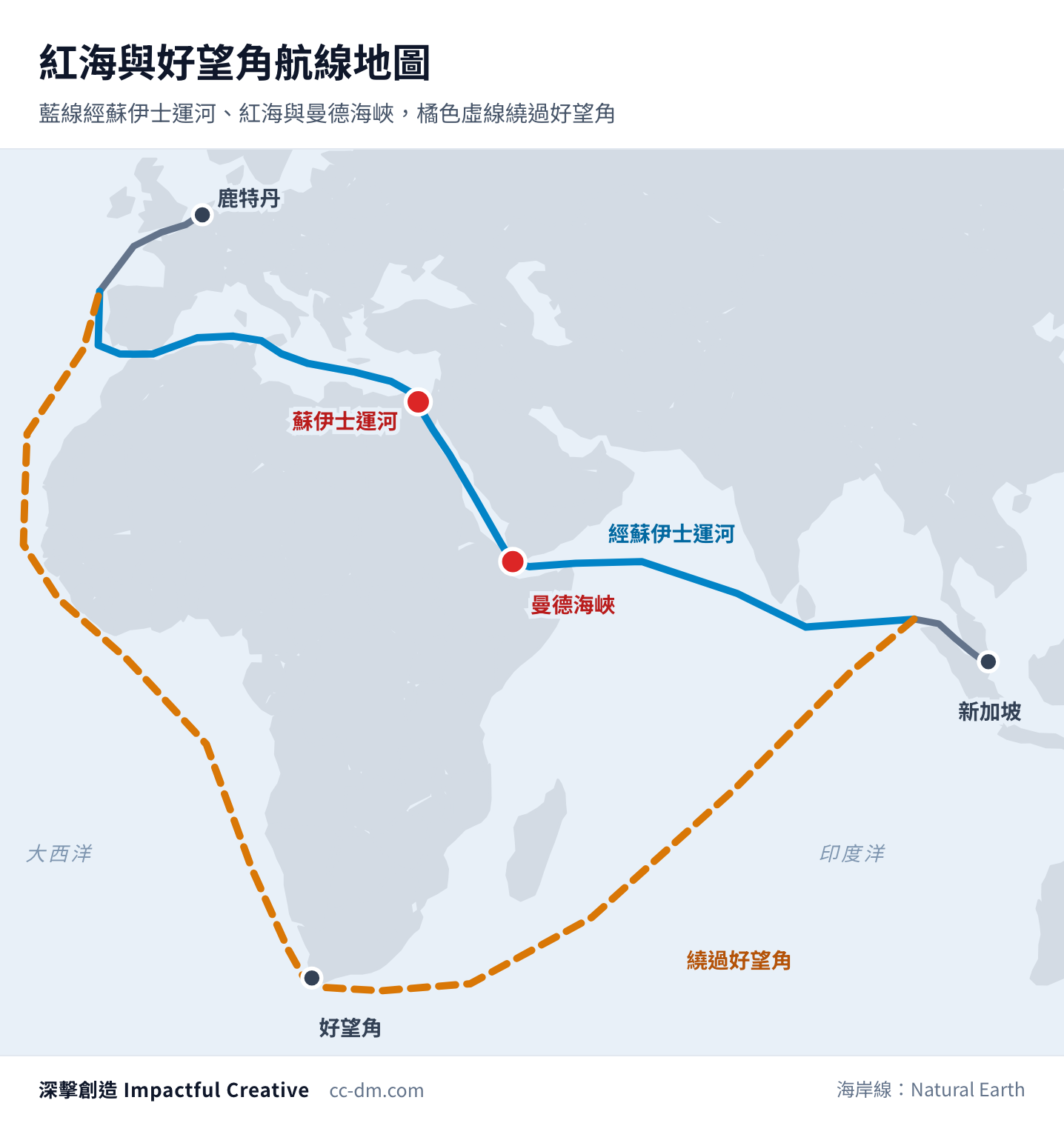
Why do ships between Asia and Europe normally go through the Red Sea?
Because it is the shortest sea route between the two. A ship leaving the Mediterranean passes through Egypt’s Suez Canal into the Red Sea, sails its full length to the Bab el-Mandeb and reaches the Indian Ocean by way of the Gulf of Aden. The International Monetary Fund (IMF) estimates that the canal normally carries about 15% of global maritime trade by volume. The UN Conference on Trade and Development (UNCTAD) estimates that around 26,000 ships passed through it in 2023, and that about 22% of the world’s seaborne container trade went this way.
The route has two gates. At the northern end is the canal; at the southern end is the Bab el-Mandeb, between Yemen and the Horn of Africa, about 29 km wide at its narrowest, with the channels tankers actually use only about 3 km wide in each direction. Both are chokepoints: unavoidable, narrow and hard to replace. A ship on this route must pass through both, so if either becomes unsafe, the whole route is compromised.
Nor is there another waterway nearby. UNCTAD notes that the Suez Canal has no ideal alternative, especially for trade between Asia and Europe; the real alternative is to sail round the Cape of Good Hope at the southern tip of Africa. Here the Red Sea differs from the Strait of Hormuz: tankers in the Gulf have no other way out to sea, whereas ships between Asia and Europe do have another route, only a far longer one. When the Red Sea is in trouble, cargo usually still arrives, just later and at greater cost.
If the strait is not closed, why do ships still divert?
Because the decision to sail is taken by shipowners, insurers and cargo owners, and they weigh the risk voyage by voyage. From November 2023 Yemen’s Houthis began attacking merchant ships in the Red Sea, and major carriers such as Maersk, MSC and Hapag-Lloyd soon diverted round the Cape.
The risk shows up first in insurance. On 18 December 2023 the Joint War Committee of the London insurance market widened its listed war-risk areas in the southern Red Sea, the Gulf of Aden and the Indian Ocean. By early February 2024, according to industry reports compiled by UNCTAD, war-risk premiums for a Red Sea transit had risen from under 0.1% of a ship’s value to between 0.7% and 1%.
Within weeks, trade had halved. The IMF estimates that trade volume through the Suez Canal in the first two months of 2024 was 50% lower than a year earlier, while volume round the Cape rose by about 74%. UNCTAD data show container-ship tonnage through the canal down 82% by the first half of February. Throughout, the canal stayed open and ships still passed the Bab el-Mandeb every day.
An attacker therefore does not need to seal the strait. Holding coastline and islands is not the same as blockading a shipping lane, but anti-ship missiles, drones, mines and small fast boats are enough to make carriers and insurers raise their risk assessments. Once the risk exceeds what shipowners are willing to bear, the ships leave of their own accord.
What does the detour round the Cape cost?
Time, first of all. The US Energy Information Administration (EIA) calculates that a laden Suezmax tanker sailing at 14 knots from the Persian Gulf to the Amsterdam–Rotterdam–Antwerp area takes 19 days via the canal and nearly 35 round the Cape. Container routes are no different: UNCTAD notes that the voyage from Singapore to Rotterdam is about 29% shorter via Suez than via the Cape. The IMF estimates that the diversions of early 2024 added 10 days or more to delivery times on average.
Then ships and fuel. On a longer voyage, a weekly service needs more vessels to keep its schedule, and ships speed up to make up lost time; for a large container ship, a 1% increase in speed typically raises fuel consumption by 2.2%. UNCTAD estimates that sending a Singapore–northern Europe round trip via the Cape raises its greenhouse-gas emissions by more than 70%.
And freight rates. On 9 February 2024 the Shanghai–northern Europe spot rate on the Shanghai Containerized Freight Index (SCFI) stood at $2,648 per twenty-foot container, three and a half times its level in early November 2023. If rates stay high, the cost passes to cargo owners and may eventually feed into consumer prices; the IMF also notes that longer delivery times hurt companies with limited inventories.
Once ships take the long way round, who loses most?
Egypt, most directly. The canal is a major source of foreign currency for the country: UNCTAD put its revenue in the last fiscal year before the crisis at about 2.3% of Egypt’s GDP. According to the Suez Canal Authority, the number of ships using the canal halved in 2024 to 13,213, and annual revenue fell from a record $10.25 billion in 2023 to $3.99 billion, a drop of three-fifths. The canal itself was never attacked; the trouble lay at the southern end of the route.
Countries on the Red Sea have even less choice. A distant carrier can take the Cape; a country whose ports lie on the Red Sea or the Gulf of Aden cannot move its trade out of these waters. UNCTAD estimates that in 2022 about 34% of Sudan’s foreign trade by volume, 32% of Yemen’s and 31% of Djibouti’s passed through the Suez Canal, against 7% of Germany’s. Yemen depends heavily on imported food, fuel and humanitarian supplies, so fewer port calls and higher insurance premiums push up local prices and the cost of relief.
Does trouble in the Red Sea also hit energy and the internet?
Yes. LNG carriers withdrew almost entirely: EIA data show LNG flows through the Bab el-Mandeb falling from about 4.2 billion cubic feet a day in 2023 to near zero in 2024, while oil flows fell from 9.3 million barrels a day to 4.1 million.
In 2026 the Red Sea also became entangled with Hormuz. With Hormuz disrupted, Saudi Arabia relied on its East–West pipeline to carry crude to Yanbu on the Red Sea coast, and in the first half of July about 75% of its crude and condensate exports left from there. But Yanbu lies inside the Red Sea: oil bound for Asia has to head south through the Bab el-Mandeb, and oil bound for Europe north through the Suez Canal. On 20 July the Houthis declared a naval blockade of Saudi Arabia, and in September they advanced down the coast to Perim, the island in the middle of the strait, as described in our analysis of the Houthi push towards the Bab el-Mandeb.
The two straits have consequently ended up in the same negotiation. According to Iranian state media, Iran has made an end to all fighting by the “axis of resistance” a condition for reopening Hormuz; after the Houthis claimed strikes on facilities at Yanbu, Saudi Arabia, Pakistan and Turkey arranged an emergency meeting of military chiefs under the Mecca Joint Defence Agreement. With both straits under military pressure, producers’ energy security can no longer rest on a single alternative route.
The internet under the sea is exposed too. The Red Sea is one of the few chokepoints where international submarine cables are concentrated. In February 2024 the dragging anchor of a cargo ship that had been attacked by the Houthis, and later sank, cut three cables; operators needed months of negotiation with the two authorities that divide Yemen, and the first cable came back online only in mid-July. The explainer If the Cable Breaks, Can Satellites Take Over? covers why such repairs are slow.
What does this mean for Taiwan?
Taiwan’s container exports to Europe normally take this route, and Taiwanese carriers sail it. When the Red Sea crisis broke out at the end of 2023, Evergreen, Yang Ming and Wan Hai suspended Red Sea transits along with the international lines. For exporters, that meant longer voyages, higher freight costs and delivery dates that were harder to pin down.
Energy is involved too. The explainer on the Strait of Hormuz traces the route that brings Gulf energy to Taiwan through the Strait of Malacca. Once Saudi crude was shipped from Yanbu on the Red Sea instead, cargoes bound for Asia had to pass the Bab el-Mandeb first. Saudi crude still made up about a fifth of Taiwan’s crude imports in March–May 2026, so risk in the Red Sea may now reach Taiwan along that detour.
The crisis also shows the order in which warning signs appear. The diversions and the rise in premiums at the end of 2023 came before any closure, and the Bab el-Mandeb was in fact never sealed. Taiwan imports almost all of its energy, all of it by sea; when judging maritime risk, it is more useful to watch war-risk premiums, sailing schedules and carriers’ route changes than to wait for news of a blockade. Those signals usually come first.
Sources
- International Monetary Fund (IMF), Red Sea Attacks Disrupt Global Trade, 7 Mar 2024
- UN Conference on Trade and Development (UNCTAD), Navigating troubled waters: Impact to global trade of disruption of shipping routes in the Red Sea, Black Sea and Panama Canal, 22 Feb 2024
- U.S. Energy Information Administration, The Bab el-Mandeb Strait is a strategic route for oil and natural gas shipments, 27 Aug 2019
- U.S. Energy Information Administration, Red Sea attacks increase shipping times and freight rates, 1 Feb 2024
- Associated Press (via Africanews), Egypt's revenue from the Suez Canal plunged sharply in 2024, 17 Apr 2025
- U.S. Energy Information Administration, World Oil Transit Chokepoints, 3 Mar 2026
- Central News Agency (Taiwan), 馬士基擬恢復紅海航線 貨櫃三雄暫不跟進, 25 Dec 2023
- United Daily News (Taiwan), 石油進口結構轉向 台灣改買美原油帶來新挑戰, 19 Jul 2026