EntryUpdated 2026/11/25
What Are the Great Powers Actually Competing for in the Arctic?
Distance, passage and rules. Seen from above the pole, the United States and Russia face each other across the Arctic Ocean, and the shortest missile paths between them cross it. Russia’s Northern Fleet must pass between Greenland, Iceland and Britain to reach the Atlantic. And as the ice retreats, who regulates the sea lanes and who may exploit the seabed have become matters of dispute.
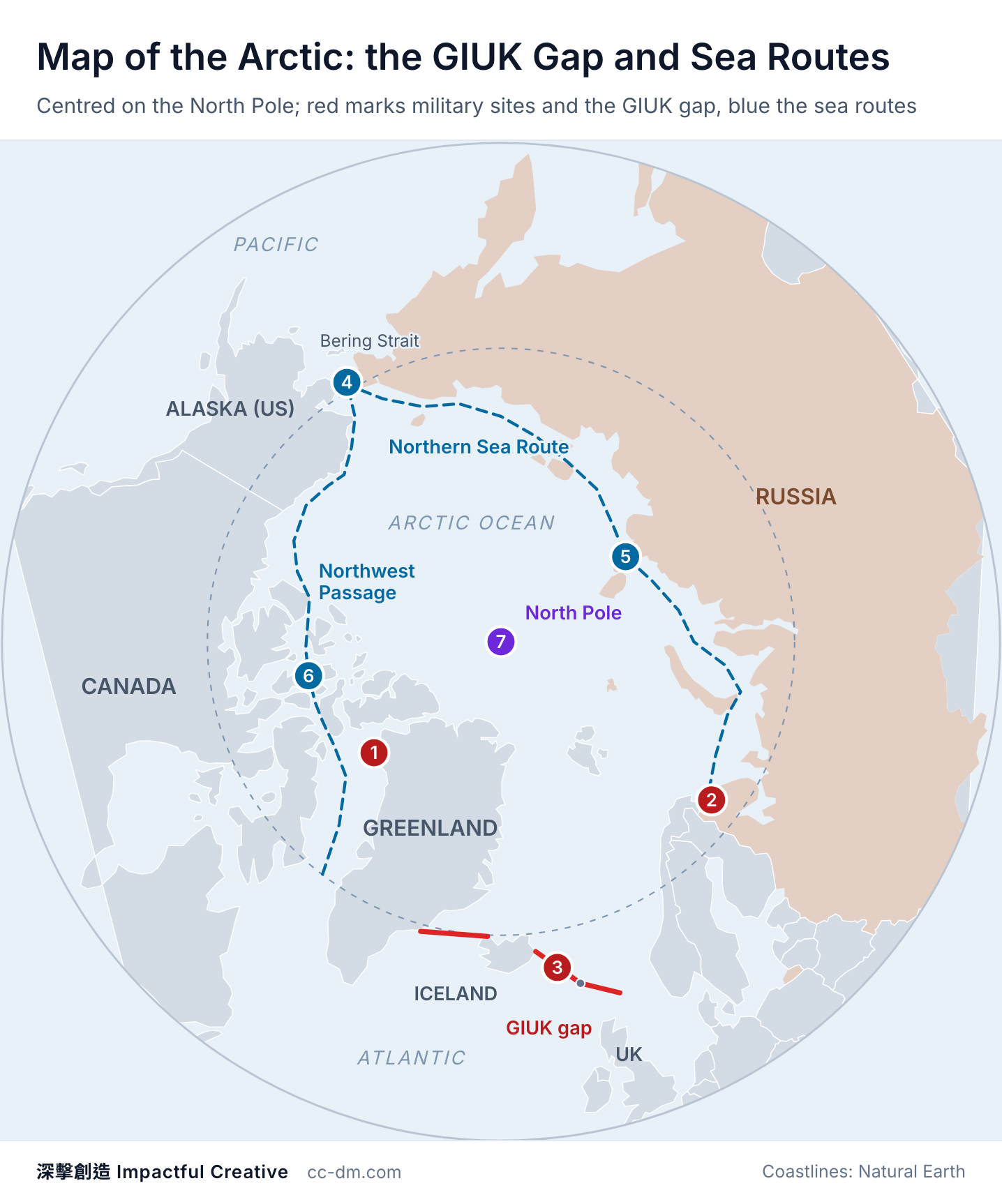
Why does the Arctic call for a different map?
The familiar world map puts the Arctic along its top edge and stretches it wide, so that it looks like the end of the earth. Centre the map on the North Pole instead and the picture changes: North America, Russia and northern Europe ring a single sea, and the Arctic Ocean sits in the middle.
This is more than a matter of drawing. The shortest route between two points on the globe is a great circle, and on a map centred on the pole any straight line through the centre is one. The Danish Defence Intelligence Service judged in 2025 that the shortest path between North America and Russia runs over the North Pole, and that in a conflict between great powers most American, Russian and Chinese ballistic missiles would fly over the Arctic.
For the United States, then, the Arctic is the first and most important line of early warning. At Pituffik Space Base, on Greenland’s north-west coast, a radar with two faces covering 240 degrees between them watches all year for ballistic missiles that could threaten the United States and Canada. About 1,500 km from the North Pole, it is the Pentagon’s northernmost installation.
What is the GIUK gap, and why is it called the Atlantic’s northern gate?
On the Pacific side, the Arctic Ocean opens to the rest of the world through the Bering Strait, between Alaska and Russia. On the Atlantic side, the Danish Defence Intelligence Service describes the waters between Greenland, Iceland, the Faroe Islands and the UK as Russia’s main maritime gateway to and from the Arctic: the GIUK gap.
That gate matters most to Russia. Most of its nuclear-armed submarines are based in the Arctic, and the Murmansk-based Northern Fleet has to cross these waters to reach the Atlantic. In a war with NATO, Danish intelligence expects Russia to try to slip attack submarines through the gap undetected to cut the supply lines between the United States and Europe, while tracking NATO submarines inside it. Even now Russia uses military and civilian vessels, fishing boats among them, as well as aircraft and satellites, to monitor NATO activity and chart these waters.
During the Cold War the West invested heavily in capabilities here to keep the gate shut. After it ended, attention moved elsewhere: a 2017 war game by the Center for a New American Security found participants unfamiliar with the gap’s geography, strategy and tactics, and concluded that no plan can adequately defend NATO’s interests in the Atlantic without access to Iceland. Danish intelligence adds that before and during a conflict Russia would seek to restrict NATO surface ships and to sabotage or attack critical undersea infrastructure (see our explainer on cables and satellites).
Why does Russia care about the Arctic more than anyone?
Because the Arctic bears on Russia’s nuclear deterrent, its military vulnerability and its economy all at once. According to Danish intelligence, most of Russia’s nuclear-armed submarines are based in the Arctic, and they are central to deterring an American attack: even after being struck, Russia would keep the ability to retaliate with nuclear weapons.
Russia also sees the north as an exposed flank. It fears it could not defend against an attack from that direction, and the retreating ice is leaving its northern coast ever more exposed; with Finland and Sweden now in NATO, regional military superiority is harder to keep. Its rearmament plans therefore put particular weight on controlling the routes into the Russian Arctic, and in July 2025 Russia’s newest nuclear-powered submarine joined the Northern Fleet.
Economically, Russia wants to exploit the Arctic’s natural resources and is promoting the Northern Sea Route as a shipping lane. It treats parts of the route as internal waters and claims the right to regulate merchant ships passing through; Danish intelligence notes that it already imposes restrictions on navigation in some northern waters beyond what the law of the sea allows, and may tighten them further.
As the ice melts, will Arctic routes replace the Suez Canal?
Not for the foreseeable future. There are two main Arctic routes: the Northern Sea Route along Russia’s coast and the Northwest Passage through the Canadian Arctic Archipelago. The US Congressional Research Service describes the Northern Sea Route as running about 2,600 nautical miles from Murmansk to near the Bering Strait, suited to trade between northern Europe and north-east Asia north of Singapore. Going over the top instead of through Suez can cut a voyage between Asia and Europe by about 7,000 km, or some ten days.
Distance is only part of the cost, though. The Northern Sea Route is navigable for just a few months a year; in 2025 the transit season ran from 30 June to 17 November. Ice conditions are hard to predict, which makes it difficult to keep the schedules container shipping depends on; ships need ice-class hulls and often icebreaker escort, and some carriers and cargo owners have pledged to stay out of the Arctic altogether. In 2025 the route saw only 103 transit voyages, just one of them running directly between Asian and European ports without starting or ending in Russia.
The Northwest Passage could serve trade between north-east Asia and north-eastern North America, but it is less commercially viable and harder going: its southern route is circuitous, with narrow, shallow channels that limit draught, while the more direct northern route is more prone to blockage by ice, and cargo transits are extremely rare. After the 2026 war in the Middle East disrupted shipping, the Northern Sea Route grew busier, with 104 transits by the end of September, yet still only four international voyages between Asia and Europe. The Suez Canal, by contrast, is open all year and saw some 26,000 ships in 2023; even in 2024, when Houthi attacks on Red Sea shipping sent many carriers round the Cape of Good Hope, 13,213 passed through. Arctic routes remain a seasonal supplement (see our explainer on the Red Sea).
Who governs the Arctic? Is there a treaty like the one for Antarctica?
No. The Antarctic Treaty preserves the status quo on territorial claims and bars new ones while it is in force. The Arctic has no equivalent: it is an ocean ringed by coastal states and governed by the UN Convention on the Law of the Sea. Each coastal state has a 200-nautical-mile exclusive economic zone, and where its continental shelf extends further it can make a claim to the Commission on the Limits of the Continental Shelf (for the basic rules on maritime boundaries, see our explainer on maritime zones).
The seabed beneath the North Pole is where the claims overlap. Russia, Denmark (on behalf of Greenland) and Canada have all submitted claims that include the pole itself. In 2023 the commission issued favourable recommendations on Russia’s claim to the Lomonosov Ridge and surrounding areas, while rejecting its claim to the Gakkel Ridge. But the commission only assesses the geological evidence; it neither draws boundaries nor settles disputes, so overlapping areas must ultimately be negotiated between the states concerned. The United States is not a party to the convention, though it accepts its navigation and overflight provisions as customary international law.
The legal status of the sea lanes is disputed too. Russia treats parts of the Northern Sea Route as internal waters, and Canada does the same for the stretch of the Northwest Passage that runs through its Arctic archipelago; the United States regards the first as international waters and the second as an international strait. As the Congressional Research Service points out, international law applies universally, so a successful challenge in one place can become a precedent elsewhere.
The main forum for cooperation is the Arctic Council, but it is not a treaty organisation. Founded in 1996 under the Ottawa Declaration, it has the eight Arctic states as members and decides by consensus; six organisations of Arctic Indigenous peoples are Permanent Participants, and thirteen non-Arctic states, China among them, are observers. The Ottawa Declaration explicitly excludes military security, and after Russia invaded Ukraine in 2022 the other seven members paused their participation in all of the council’s meetings.
The Arctic is a long way from Taiwan. Why should it matter here?
First, Arctic routes offer Taiwan no way out of shipping risk. Taiwan lies within the range the Northern Sea Route could serve, but the route is open only a few months a year and passage depends on Russian permission and icebreakers. AFP reports that foreign ships must pay Russia for navigation and weather services along the way, which experts fear could cross the red lines of Western sanctions (on how sanctions reach third parties through payments and insurance, see our explainer on sanctions). Spreading shipping risk depends on sources, stocks and insurance, not on a seasonal sea lane.
Second, the Arctic’s disputes over sea lanes turn on the same rules that govern the waters around Taiwan. Russia and Canada treat their routes as internal waters, while the United States insists on international waters and an international strait; navigation rights around Taiwan rest on the same law of the sea. Whichever position prevails in the Arctic may be cited in other seas.
Third, the Arctic is one more place to watch China’s military reach. Danish intelligence judges that Beijing wants to be able to operate surface ships and submarines in the Arctic on its own within five to ten years, with the longer-term aim of hiding missile-carrying submarines under the ice; in the summer of 2024 Chinese and Russian strategic bombers flew their first joint patrol north of the Bering Strait. China has no military presence in the Arctic today, which makes its progress there a useful measure of how far the People’s Liberation Army can reach.
Sources
- Danish Defence Intelligence Service, Intelligence Outlook 2025, Dec 2025
- U.S. Space Force, 821st Space Base Group, Apr 2024
- U.S. Space Force, Buckley Space Force Base, 12TH SPACE WARNING SQUADRON, 2023
- U.S. Space Force, Peterson-Schriever Garrison, Pituffik SB, Greenland, 2026
- Congressional Research Service (copy hosted by Penn State), Changes in the Arctic: Background and Issues for Congress, 2 Jul 2025
- Center for a New American Security (CNAS), Forgotten Waters: Minding the GIUK Gap, 2 May 2017
- Central News Agency (Taiwan), citing AFP, 韓緊跟中國腳步試航新海路 搶進北極航運卡位戰, 22 Aug 2026
- Centre for High North Logistics (CHNL), Nord University, Main Results of NSR Transit Navigation in 2025, 9 Dec 2025
- Centre for High North Logistics (CHNL), Nord University, Overview of NSR Transit Voyages as of September 30, 2026, 9 Oct 2026
- UN Conference on Trade and Development (UNCTAD), Navigating troubled waters: Impact to global trade of disruption of shipping routes in the Red Sea, Black Sea and Panama Canal, 22 Feb 2024
- Associated Press (via Africanews), Egypt's revenue from the Suez Canal plunged sharply in 2024, 17 Apr 2025
- Secretariat of the Antarctic Treaty, The Antarctic Treaty, 1 Dec 1959
- ArcticToday, Like Denmark and Russia, Canada says its extended continental shelf includes the North Pole, 30 May 2019
- Arctic Council, Organization, 2026
- Arctic Council, Observers, 2026